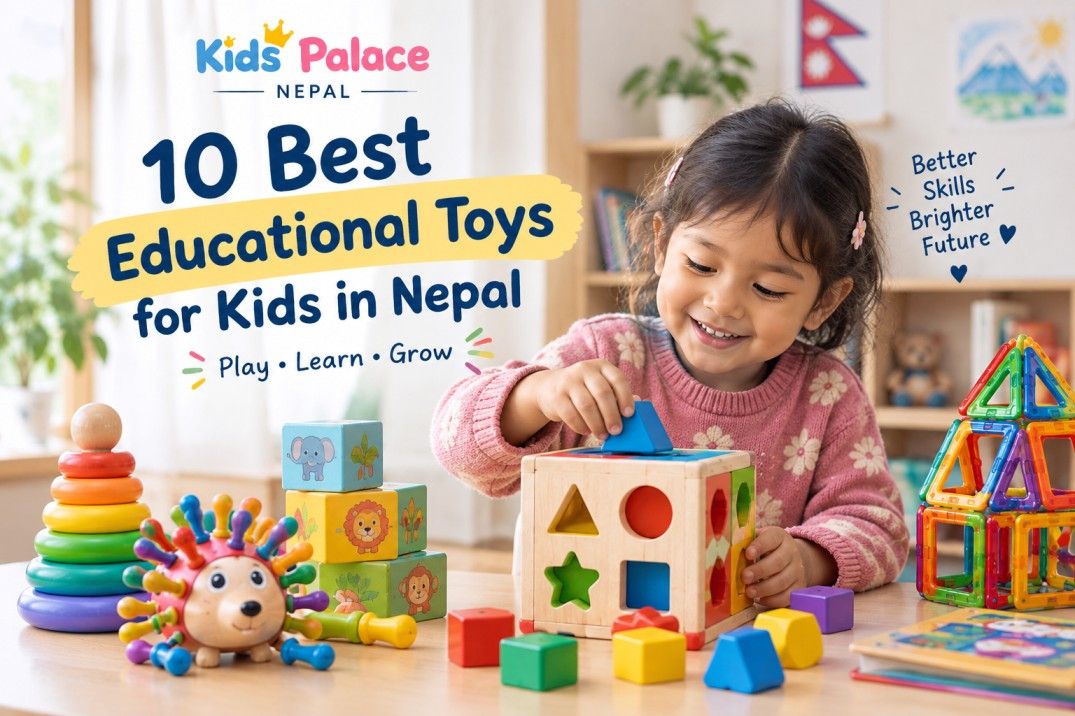
Choosing toys for children is not only about finding something fun to play with. The right toy can also encourage children to explore, think, build, match, sort, and develop new skills through play.
For parents in Nepal, there are many different types of children's toys available, but choosing the right one can sometimes be difficult. Parents often want toys that are entertaining while also supporting their child's learning and development.
Educational toys can make playtime more meaningful by giving children opportunities to develop skills while having fun. In this guide, we explore 10 educational and developmental toys for kids in Nepal and the skills children can practice while playing with them.
The 7-in-1 Shape Sorting Box combines several early-learning activities in one toy. Children can explore shape matching, color recognition, number learning, clock play, and other activities while playing.
This type of toy can help children practice:
Shape recognition
Color recognition
Number recognition
Fine motor skills
Hand-eye coordination
Problem-solving
Having several activities in one toy gives children different ways to learn and explore.
Why consider it: It combines learning and play in one interactive toy, making it a useful choice for young children who are beginning to explore shapes, colors, and numbers.
The Hedgehog Educational Fine Motor Skills Toy is designed for hands-on learning. Children can remove and insert the colorful spikes, giving them an opportunity to practice grasping, placing, and manipulating objects.
Children can practice:
Fine motor control
Hand-eye coordination
Color recognition
Sorting
Matching
Finger movement
Simple activities such as picking up, inserting, and arranging pieces can give young children valuable opportunities to practice coordination.
Why consider it: It turns a simple hands-on activity into an engaging way for children to practice fine motor skills and early learning concepts.
Children who enjoy dinosaurs and animals may find the Pop-Up Dinosaur Shape Sorter especially engaging.
The toy combines colorful dinosaur pieces with shape-matching activities, giving children an opportunity to learn while playing.
It can encourage children to practice:
Shape matching
Color recognition
Fine motor skills
Problem-solving
Hand-eye coordination
Imaginative play
Combining a familiar and exciting theme such as dinosaurs with learning activities can make educational play more enjoyable.
Why consider it: It introduces early learning concepts through an activity that can capture a child's interest and encourage hands-on exploration.
The 7-Sided Busy Cube Educational Sensory Activity Toy gives children several activities to explore in one compact toy.
The different sides can include features such as spinning wheels, sliding tracks, switches, opening doors, rotating elements, and other interactive activities.
These activities can help children practice:
Fine motor skills
Hand-eye coordination
Concentration
Problem-solving
Exploration
Cause-and-effect learning
Because there are several activities to discover, children can explore the toy in different ways instead of repeating just one activity.
Why consider it: It provides multiple hands-on activities that encourage children to touch, move, explore, and discover.
The Silicone Geometrical Shape Toy introduces children to different shapes through hands-on exploration.
Shape-based activities can help children become familiar with:
Shape recognition
Matching
Sorting
Coordination
Fine motor skills
Visual learning
Young children can learn about shapes by touching, holding, comparing, and arranging different pieces.
Why consider it: Its simple design makes it suitable for introducing young children to shapes and hands-on learning.
The 3-in-1 Shape Rolling Drum combines movement with shape-based learning, giving children an opportunity to explore while playing.
A toy like this can encourage children to practice:
Shape recognition
Movement
Coordination
Matching
Hands-on problem-solving
Adding movement to learning can make playtime more active and engaging for young children.
Why consider it: It combines physical interaction with early-learning concepts, giving children more than one way to engage with the toy.
The Magnetic Sticks Developmental Kids Toy is a construction-based toy that allows children to connect pieces and create different structures.
Construction play can encourage:
Creativity
Construction skills
Spatial awareness
Problem-solving
Hand-eye coordination
Imagination
Unlike toys with only one correct way to play, construction toys allow children to experiment with their own ideas.
Why consider it: Children can build different shapes and structures, making every play session an opportunity for creativity and exploration.
Magnetic Tiles are another creative construction toy that allows children to experiment with shapes, patterns, and structures.
Children can use the pieces to create different designs while practicing:
Creativity
Spatial thinking
Construction skills
Problem-solving
Coordination
Imagination
As children experiment with different combinations, they can begin to understand how shapes and pieces fit together.
Why consider it: Magnetic construction play encourages children to experiment, create, and learn through trial and error.
The Activity Pyramid gives children different elements to explore and interact with during play.
Activity-based toys can encourage:
Hand-eye coordination
Fine motor skills
Concentration
Exploration
Problem-solving
Children can interact with different parts of the toy, discovering how each element works through hands-on exploration.
Why consider it: Multiple interactive elements can keep children engaged while giving them opportunities to practice coordination and concentration.
Soft Blocks with Storage Box give children an opportunity to build, stack, and create their own structures.
Block play can encourage:
Creativity
Imagination
Coordination
Spatial awareness
Construction skills
Problem-solving
Children can build towers, houses, shapes, or completely new creations based on their imagination.
The storage box can also encourage children to develop a simple habit of organizing their toys after playtime.
Why consider it: Soft blocks provide open-ended play, allowing children to use their creativity and come up with new ideas every time they play.